
la musculatura más trabajadora del cuerpo ¿por qué querer eliminarla?
abr 12, 2026
Title: The hardest working muscle in the body: Why would we want to eliminate it? Author: Huang Tao, founder of Baoshi Sports Rehabilitation Clinic in Beijing, former physical therapist specializing in sports medicine at Peking University Shougang Hospital. Review: Ji Gang, deputy director of orthopedics at the First Hospital of Hebei Medical University and member of the Regeneration and Rehabilitation Committee of the Chinese Society of Rehabilitation Medicine. Planning: Zhen Xi. Editor: Zhen Xi. Review: Xu Lai, Zhang Linlin. Source: Official WeChat of China Popular Science. Note: The images used in the article and its content come from a copyright image library. Reprinting may lead to copyright disputes.
The image comes from the Internet.
The trapezius is actually a very amiable muscle; it is always willing to help those in need, ready to compensate for any effort.
When there are difficulties everywhere, those that deviate are willing to help.
No matter where it is exercised, the trapezius will feel pain.
Everyone underestimates it, but that's precisely why it's the most tenacious and shows the most progress in training.
When you are about to give up, think about how the trapezius is still working hard!
Not practicing will also lead you to practice...
Is the trapezius muscle really as ‘helpful’ as it's said to be? Why does it get worked even if not specifically trained?
The trapezius muscle is actually very important.
The trapezius is a muscle that many people are familiar with but is also often misunderstood. It is located in the neck and upper back, extending from the back of the skull and cervical vertebrae to the thoracic vertebrae, continuing towards the clavicle and scapula. Its shape resembles a large kite, hence its name 'trapezius'.
It is not simply a small set of 'aesthetically unpleasing muscles', but rather a very important muscle group that is generally divided into three portions: the upper portion, the middle portion, and the lower portion. The upper portion is responsible for elevating the shoulders and assisting in lifting the scapulae; the middle portion is responsible for retracting the scapulae; and the lower portion takes care of the depression and upward rotation of the scapulae. In short, when you raise an arm, pull something, stabilize the scapulae or maintain the position of the head, neck, and upper limbs, it all depends on this muscle group.
The images in the gallery are protected by copyright; their reprinting and use may lead to copyright disputes.
In recent years, the aesthetic of 'right-angled shoulders' has become very popular, leading many individuals to perceive that a slight development in the trapezius means that they have 'trained poorly', that 'their shoulders don't look good,' or that 'their trapezius is too tense.' However, right-angled shoulders are largely influenced by clavicle length, acromion shape, scapula position, body fat distribution, and natural skeletal structure; it cannot be simply achieved by eliminating the trapezius. From a functional perspective, there is nothing wrong with having a well-developed trapezius.
A trapezius that is strong, has endurance, and can stabilize the scapula often means that the shoulder-neck system is better supported and can withstand the load of work, training, and daily life. Between the aesthetics and function of the trapezius, there should be a greater emphasis on function first. Comfortable shoulder and neck, effective upper limbs, and more stable athletic performance are far more valuable than solely pursuing a visually 'thin' and 'flat' appearance.
The real problem with the trapezius is that it is too fatigued.
Regarding the trapezius, the real issue is not 'the trapezius is too big', but rather that it is overworked for long periods when it shouldn't be and experiences chaotic exertion during times it should work cooperatively.
Why is it so easy for the trapezius to feel sore? The reason is simple: modern lifestyle frequently keeps it in a state of low quality and high load, meaning the trapezius is subjected to excessive strain for extended periods.
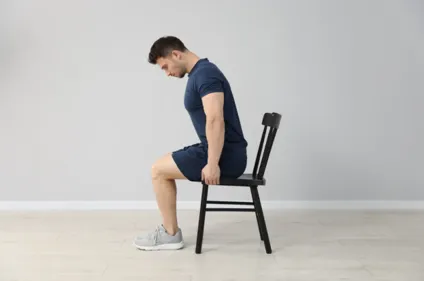
Spending too much time seated in an office, using a computer for long periods, looking at screens, bending down to look at phones, driving, and lack of strength training can all lead to the head projecting forward, exacerbating thoracic spine mobility and causing abnormal scapula positions. Once the head leans forward, the trapezius, especially its upper part, must work excessively, as if someone is pulling your neck and shoulders all the time.
Additionally, many individuals have almost never truly trained for scapular stability and upper back strength. The muscles lack both strength and endurance, and for a long time have been in a state of tension and shortening, leading to sensations of pain, swelling, stiffness, tenderness, and a feeling that they become tighter with fatigue. Strictly speaking, many individuals do not have 'too strong' trapezius muscles; rather they are 'too fatigued'.
The images with copyright in the gallery may lead to copyright disputes if used without permission.
For beginners in fitness, the most common problem during training is trapezius compensation. This is because during exercise, the coordination of the relevant muscles becomes chaotic.
The main reason for this is that beginners often lack awareness of shoulder relaxation, coupled with weak core and deep stabilizing muscle strength; during presses, lateral raises, or even back exercises, the trapezius becomes the main force in completing the movements because it is the easiest to activate.
Furthermore, most modern individuals experience problems with trapezius muscles that are in a state of constant tension and shortening. These muscles are activated more easily than others; as soon as weights are lifted, the trapezius tends to 'jump' and engage immediately.
The image is from the user @阿甜的小红薯 on Xiaohongshu.
There are various methods to exercise the trapezius, here are some effective exercises: 1. Dumbbell Shrugs: Hold a dumbbell in each hand, standing or sitting upright. Slowly lift your shoulders as if trying to bring them close to your ears, then lower them slowly and repeat. 2. Barbell Shrugs: Similar to dumbbell shrugs, using a barbell. Grip the barbell with both hands, standing or sitting upright, and lift and lower your shoulders similarly. 3. Rowing Movement: Using dumbbells or training equipment, pull your arms back, retracting the scapulae while maintaining an upright back. 4. Bent-Over Stretch: Bend over using dumbbells or a barbell for stretching, letting your arms hang down and pulling back, making sure to maintain stability in your movements. 5. Resistance Band Lateral Raises: Use resistance bands for lateral raises to help exercise the side of the trapezius. It is recommended to start with a weight suitable for your strength, progressively increasing the load while maintaining proper posture to avoid injury. Additionally, exercising several times a week, combined with adequate rest and nutrition, will help enhance results.
To relieve discomfort in the trapezius, the first step is not to rub or press hard, but rather to reduce 'ineffective extra work' first. For example, lift the screen a little, place the keyboard and mouse closer, avoid shrugging your shoulders while typing for long periods, and do not maintain the same posture for one or two continuous hours. It is not necessary for the posture to be always perfect; what matters is to change it frequently. It is much more relevant to stand up and move your shoulders, thoracic spine, and neck every three or four minutes than to obsess over finding a 'perfect posture'.
You can perform trapezius stretches, but they should be done gently. The most common method is to sit up straight, hold the chair with one hand to stabilize the body, and slowly bring one ear towards the opposite shoulder, allowing the neck to stretch gently to one side. If you want to stretch the upper trapezius more, you can tilt your head slightly downwards, looking toward the opposite pocket. You should not pull firmly or chase the idea that 'the more it hurts, the more effective it is.' Hold each stretch for twenty to thirty seconds and perform two to four sets. Many people tend to shrug their shoulders while stretching, which can actually cause more tension; hence, the key is to let the shoulders relax and breathe deeply.
Images owned by the gallery; unauthorized use may lead to copyright disputes.
But just stretching without exercising typically does not resolve the underlying problem. What the trapezius really needs is to regain its normal function. The trapezius training can be seen separately:
The upper portion can still be trained; shrugs and farmer carries can engage it.
Training in the middle and lower ranges should receive more attention from most people, such as rowing exercises, Y/T/W movements emphasizing scapular control during pull-ups, wall slides, and engaging the trapezius in low positions, among others.
The purpose of these trainings is not just to increase muscle size, but to teach the scapula to stabilize, retract, upwardly rotate, and depress, reducing shoulder-neck compensation. Many individuals who experience discomfort in their shoulders and necks are not truly lacking 'relaxation', but rather 'stability'.
Therefore, the most important idea about the trapezius is that it is not an enemy. Having a well-developed trapezius is not a problem in itself; the issue lies in prolonged imbalance, continuous compensation, insufficient use, and constant overload. Instead of pursuing a trap-less appearance, it is better to seek a strong trapezius that can collaborate and not be overloaded. The aesthetically pleasing lines of the shoulders and neck may be influenced by aesthetics; however, a comfortable, stable, and functional shoulder and neck system is what can truly accompany you for a long time.
Planning and Production
#rehabilitación deportiva
#salud muscular

© 2025 Tribu Salud.