
La presión mental puede debilitar la defensa contra el cáncer según un estudio reciente
feb 09, 2026
Title: Mental pressure can weaken defense against cancer according to a recent study. Profile: Study from the University of the West Lake shows that stress weakens the immune system and increases cancer risk. Keywords: ['health', 'research'].
After working late, I get stress pimples on my face; after arguing with my family, I feel a slight discomfort in my stomach... We often feel the "traces" our emotions leave on the body.
Recently, the research team from Xihua University revealed a key factor behind this. Continuous mental stress can also interfere with the combat capability of the body's "anti-tumor patrols", allowing abnormal cells to thrive. On January 30, the teams of Zhang Bing and Zhou Ting from Xihua University and the Xihua Laboratory published their joint research findings in the prestigious international academic journal "Cell".
In the surface tissues of our body, such as skin and respiratory tract, there is an important "immune patrol"—CD8⁺ TRM cells. They act like security guards at the front door, always ready to detect and eliminate cancer cells.
Through experiments with mice, the research team discovered that when in a state of stress, the body's "sympathetic nervous system" is overactivated, quickly reducing CXCL16 in epithelial cells, weakening the supply of circulating T cells to the skin, leading to a decrease in the number of CD8⁺ TRM cells in the epithelium.
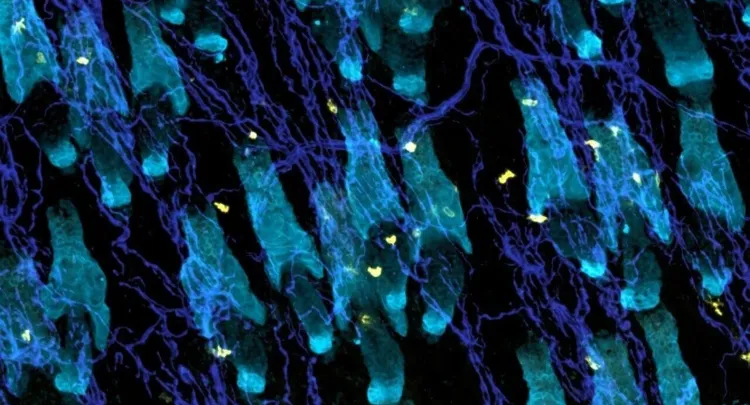
In the skin of the mice, the structure of the blue-green epithelial hair follicles is surrounded by a dense network of blue sympathetic nerve fibers, which contain yellow TRM CD8⁺ cells. Image provided by Xihua University.
The decrease in the number of "immune patrols" causes local immune surveillance to temporarily present a "low alert window": viruses proliferate more easily, and early-stage abnormal cells are more likely to escape timely elimination, thus accelerating tumor progression.
All of this originated from a chance discovery in an experiment.
Assistant Professor Zhang Bing from the School of Biological Sciences at the University of the West Lake discovered while observing mice that if certain "pressure nerves" in the skin were cut, the early development of skin cancer could be significantly slowed down. "Are these nerves obstructing the immune system?" he wondered, leading him to collaborate with Zhou Ting, an expert in immunological research. Together, these two scientists, after numerous explorations, managed to uncover a whole series of immune action mechanisms.
Research team, left to right: Zhou Ting, Miao Jujun, Zhang Peng, Zhang Bing. Image courtesy of the University of the West Lake.
When immune defenses are weakened, if there are cells that begin to transform into cancerous ones, they could evade surveillance and grow silently. This "defensive window period" created by stress becomes a risk stage for the onset of cancer.
It is said that prolonged stress harms health. This study not only validates the intuition that body and mind are connected, but also issues a warning:
Regulating emotions and managing stress is not just for feeling good; it is also to keep our "anti-cancer patrol team" in the body strong.
Sometimes, relaxing a bit can really save lives.
#salud
#investigación


© 2025 Tribu Salud.