
viajar en coche durante el embarazo recomendaciones sobre el cinturón de seguridad
feb 22, 2026
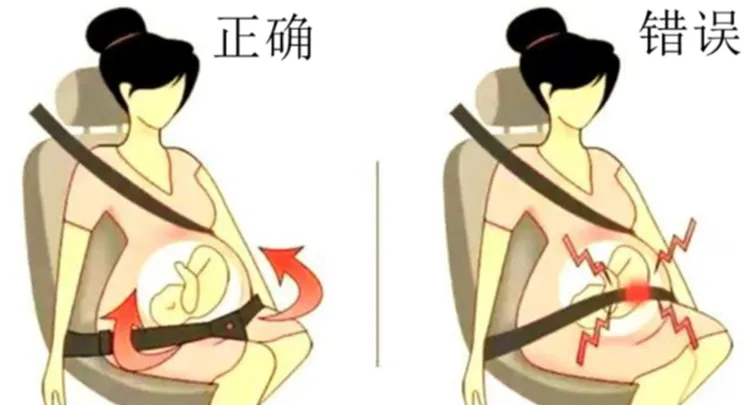
Title: Traveling by Car During Pregnancy: Recommendations on Seat Belts Author: Not specified Reviewer: Not specified Commissioner: Not specified Production/Organization Info: Not specified Pregnant women should wear seat belts while driving to protect themselves and care for the fetus, especially during trips such as the Chinese New Year.
During the Spring Festival, many pregnant moms traveling by car will debate a common question: Will the seat belt press against their belly? In the event of a sudden brake, could it harm the baby? Some even choose not to wear the seat belt to 'protect' the fetus, which is an extremely dangerous practice.
Firstly, pregnant moms must buckle up; this is the first line of defense to protect the baby.
First, it is essential to clarify a fundamental principle: throughout the pregnancy, it is crucial to wear the seat belt. Many expecting moms fear that the seat belt will press against their abdomen, but in reality, it is the opposite: in the event of an accident or sudden braking, pregnant women who do not wear the seat belt are at a much higher risk of harm to the fetus. Study data indicates that when a pregnant woman suffers a traffic accident without wearing a seat belt, the fetal mortality rate is 2.8 times higher than for those who do wear one. This is because, in the event of a sudden stop or collision, the mother’s body will lurch forward due to inertia, colliding either with the steering wheel or the dashboard, or falling; meanwhile, the fetus inside the uterus can impact against the walls of the uterus or the mother’s bones due to the strong inertia, potentially leading to serious consequences such as placental abruption. Therefore, wearing a seat belt is not a limitation for the mother, but a measure to keep the baby well protected in a relatively safe 'cocoon' during moments of danger.
Secondly, the 'three-step method' for future moms to correctly wear the seat belt.
So, how can one wear the seat belt to provide protection without putting pressure on the abdomen? Remember the following three points:
Step one: adjust the seat position.
Upon getting into the car, first adjust the seat and find a position that allows you to comfortably press the brake and accelerator while maintaining an adequate distance from the steering wheel.
Key points: It is best to maintain a distance of more than 25 centimeters between the sternum and the bottom edge of the steering wheel. Being too close is not only dangerous in the event of an accident, but it also increases the sensation of restriction from the seat belt.
Step two: the seat belt should be placed 'under the belly', this is the most crucial step.
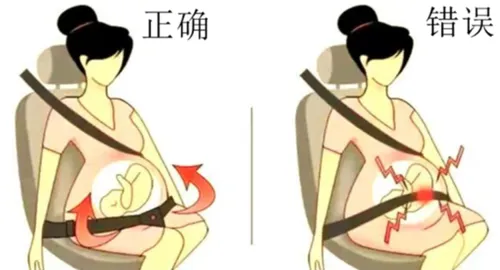
· Correct: The part of the seat belt strap should cross the hip (hip bone), fitting over the top of the thigh, and should be completely placed just below the prominent abdomen.
· Incorrect practice: adjusting the belt over the abdomen or pressing it at the navel area.
Why should it be placed lower? Because when a collision occurs, the body's force transfers to the strong pelvic skeleton, rather than to the weaker abdomen. The seat belt must be positioned below the stomach to secure the body without pressing on the uterus.
Step three: the strap should go across the middle of the chest.
The function of the strap is to secure the upper body and prevent forward leaning. It should cross the chest comfortably, without tightening the neck or slipping out over the arm.
The correct positioning is: the strap should pass through the center of the chest (between the breasts), wrap around the top of the abdomen, and adjust to the clavicle and the center of the chest.
· Common mistakes: straps that tighten the neck or wrap around the back (this completely negates its protective function).
Standard check: Once buckled up, try to grip the seat belt at the abdomen with your hand; the thickness of a palm should fit between the seat belt and the stomach, neither too tight nor too loose.
Three, special reminder: these 'makeshift methods' are very dangerous.
Some pregnant moms, to protect their bellies, come up with certain 'homemade methods', but these practices can actually be more dangerous.
Only buckle the shoulder belt, not the waist belt: during sudden braking, the body may slide down, exerting direct pressure on the fetus.
· Placing the straps behind the back: the upper body loses complete restraint and the person may collide directly with the steering wheel.
Putting a cushion on the abdomen: during an impact, the cushion might fly away and increase the distance between the seat belt and the body, which can actually result in a higher chance of injury.
· Resting hands on the dashboard: In sudden braking, the arms cannot withstand the impact and it is easier to suffer a fracture.
Four. Important points for resting during a long car journey.
In addition to buckling the seat belt, driving for extended periods is a challenge in itself for future moms. Sitting for too long can affect blood circulation and increase the risk of edema in the lower extremities and thrombosis. Below are some key points for resting:
1. Resting frequency: It is recommended to stop and rest every hour.
Pregnant women have slower blood flow, and compression from the uterus on the vena cava can lead to edema in the legs and venous thrombosis if one remains seated for too long.
It is recommended to stop to rest for 15 to 20 minutes every hour of driving, or when you feel numbness in your legs or back pain. Do not rush on the road; your body and your baby also need to 'relieve' themselves.
2. What to do after getting out of the car?: Walk + Elevate the legs.
When you take a break during driving, do not just change positions in the seat. Get out of the vehicle and walk for 5 to 10 minutes to promote blood circulation in the lower extremities. If conditions permit, find a place to sit and elevate your legs (for example, resting them on the curb or a step) to assist venous return.
3. Actions that can be performed in the car.
If it is inconvenient to stop frequently on the highway, you can do some 'invisible exercises' in your seat:
· Ankle exercise: alternate between flexing your toes and stretching them, this movement is called 'venous pump' and effectively helps to prevent blood clots.
Dress appropriately.
- Wear loose clothing: avoid tight pants and girdles; choose wide cotton trousers and comfortable flat shoes.
· Use medical compression stockings: If you already have edema in the lower extremities or varicose veins, you may wear medical-grade compression stockings during long trips.
Five, special cases that require attention.
· First trimester of pregnancy: Although the belly may not be obvious, it is important to buckle up. If nausea is severe, carry plastic bags and fresh snacks in the car.
- Third trimester of pregnancy: Unless necessary, long-distance driving is not recommended. If travel is essential, it is advised to sit in the back seat and ensure to stop every hour to get some movement.
· Twin or multiple pregnancies: the uterus is larger, and the feeling of pressure is more intense, so the frequency of breaks should be higher.
For pregnant moms, correctly fastening the seat belt is the most basic expression of love for their baby. Do not give up protection because of fear of pressure on the belly, nor should you replace scientific protection with makeshift methods like pillows or hand supports.
#salud de la mujer embarazada.
#viajar de manera segura.

© 2025 Tribu Salud.