
¿El crujido en la rodilla en primavera es preocupante? Descubre la verdad.
abr 08, 2026
Title: Is knee cracking in spring a cause for concern? Discover the truth. Author: N/A, Reviewer: N/A, Commissioner: N/A, Organization: N/A
Spring arrives, the weather warms up, and many people resume their exercise plans that they had put off throughout the winter. Some start walking briskly, others run slowly, and some immediately pull out their running shoes, ready to run seriously.
However, the reality is often that as soon as a person starts moving, their knee begins to "sound". It clicks when going down stairs, crouching, or even after running just a few steps. Some people only hear a "click", while others may hear "grinding" or "creaking", and may even feel some pain or discomfort. As a result, many get nervous immediately: Is my knee worn out? Does my meniscus have problems? Will I never be able to run again?
In fact, in most cases, the fact that the knee makes noise does not mean it is "damaged". This is especially common when resuming physical activity in spring or restarting running. Many problems are not solely due to knee failures but are related to too rapid an increase in running load, a lack of strength in the lower limbs, poorer movement control, and instability in walking. In other words, the "cracking" of the knee is often not a localized issue but a result of minor deviations in pressure and control throughout the entire running process.
1. What exactly is causing the knee to "creak"? The question about the "crackling" sound that sometimes occurs in the knees is common and can cause concern. This sound, known as crepitus, often occurs when the tissues in the joint move against each other. Generally, it is not a cause for alarm and can result from gas bubbles in the synovial fluid, ligaments or tendons sliding over bones, or changes in joint surfaces. However, if the sound is accompanied by pain, swelling, or stiffness, it is advisable to consult a doctor for a more detailed evaluation.
In medicine, the sound produced when mobilizing a joint is termed "joint click". It can be classified into two main types.
1. Physical or physiological sound. This type of click is quite common and generally does not indicate a significant issue. For example, you may hear a "click" now and then when moving a joint, but if there is no apparent pain, swelling, or impairment of mobility, it is often simply due to changes in pressure within the joint, the formation and rupture of bubbles, or slight friction of tendons or soft tissues against bony structures. This sound is more like a "noise" and does not necessarily indicate an injury.
2. We need to be alert for abnormal clicks. If the sound is frequent and manifests as a rough "cracking" or friction feeling, accompanied by: pain, swelling, difficulty moving, discomfort when going up and down stairs, and increased symptoms after running, this indicates it is not just an "occasional noise". Rather, it suggests that there may be issues with uneven pressure in the knee joint, improper trajectories, or local overstimulation during movement.
For those resuming exercise in spring, a common situation is that after running, there is increased pressure on the patellofemoral joint, and the movement path of the patella is not ideal, leading to friction and discomfort at the front of the knee, sometimes accompanied by a popping sound. Simply put: the knee is moving, but not along the "most comfortable path".
Why do knee problems more easily arise when resuming running in spring? This is not so much related to 'spring' itself, but primarily because many people suddenly shift from low-frequency to high-frequency activity. During winter, sitting for long periods and limited movement leads the body to experience several common changes: decreased strength in the lower limbs and glutes, poorer core and pelvic control, decreased ankle flexibility, decreased competence in running movement, and a reduced ability of the body to adapt to impact loads, among others.
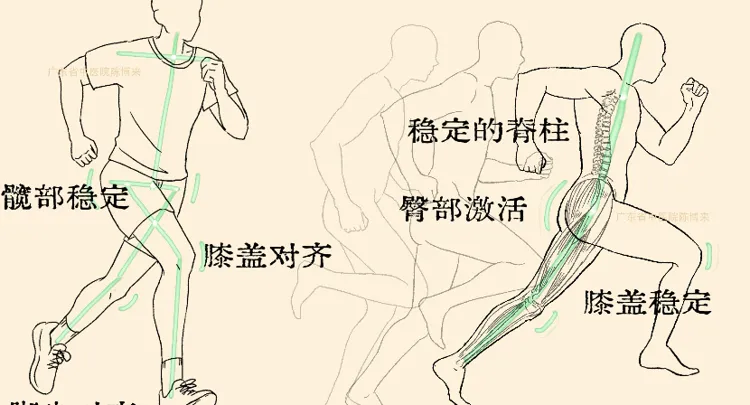
However, as spring arrives, many people begin to exercise too casually: after a long time without running, suddenly running 5 kilometers; unaccustomed to exercise, suddenly training intensely on weekends; starting to chase a pace or distance without adequately warming up, focusing only on whether their knee hurts, without paying attention to overall movement. At this moment, the knee is often the most prone to issues. Because running, essentially, is a continuous movement that involves the whole body. With each landing, force transmits along the foot-ankle-knee-hip-pelvis-trunk chain. If any of these links are not well controlled, the knee may bear more pressure than it should alone.
Three simple signs that can help you decide whether to see a doctor. If the following situation occurs, do not wait any longer:
If the knee shows significant swelling, nighttime pain that worsens continuously, locking, weakness in the legs, difficulty extending or flexing smoothly, and the pain becomes more apparent after running. Additionally, daily walking and going up or down stairs are affected, and there is a clear history of sprains or injuries. In this case, it is necessary to consider the possibility of actual injuries in the meniscus, ligaments, cartilage, or the patellofemoral joint, and one should go to the orthopedics department of the hospital.
Spring and how to start solidly.
1. Don't start running immediately, first wake up your body.
During the first 2 to 3 weeks of returning to running, the focus should not be on running fast but on allowing the body to adapt to the rhythm of repeated impact. You can start as follows: combining walking and running, starting with short distances, slowly increasing running volume each week, and reserving recovery days, not running every day. For those who have been inactive for a long time, it is much more important to maintain continuity in running than to chase times in the first week.
2. Warm-up before running, do not just stretch your legs.
Before running, instead of static stretching for half a day, it is better to do some dynamic exercises more in line with the activity, such as opening and closing the legs, lifting the knees, running in short quick steps, mobilizing the hips, and activating the ankles, among others. This will help raise body temperature, increase joint mobility, and optimize neuromuscular control, making the first kilometer feel less "stiff".
3. Strengthening the glutes, working the legs, and improving control is more useful than only protecting the knees.
If every time you feel discomfort in your knee, your first reaction is to buy knee braces or apply patches, you are generally only treating symptoms, not the underlying cause. For runners, it is vital to work on these basic capacities: training the gluteus medius: lateral opening and closing, walking with a resistance band; training the gluteus maximus: glute bridges, step-ups; training the quadriceps: wall sits, sit-to-stand exercises; core stability training: dead bugs, bird dogs, planks; single-leg control training: standing on one leg, single-leg squats, among others.
4. When running, first seek "lightness" and "stability", do not rush to seek the "big" and "fast".
A more knee-friendly way of running typically has the following characteristics: moderate stride, gentle landings, body height movements that are not excessive, the direction of the knees generally aligns with the toes, the torso is naturally stable, the rhythm is even, avoiding sudden accelerations or decelerations.
You do not need your running movements to be "very professional", but at least you should avoid running in a way where each step strikes the ground, your hips rotate, and your knees move unstably. The friendliest form for the knees while running is not to "hold your breath and strain", but rather to "be a little lighter, more stable, and slower". Remember that if you feel any discomfort, you must seek medical attention immediately!
#habilidades deportivas
#articulación de la rodilla

© 2025 Tribu Salud.