
Cómo el cruce de la córnea puede mejorar la cirugía de miopía
abr 09, 2026
Author: Zhang Jia, Liu Chang, Li Yini, et al. Reviewer: 熊洁, Zhang Chenxing, Wang Ke, et al. Production information: Cirugía de queratectomía terapéutica con láser excimer combinada con cross-linking corneal para el tratamiento del queratocono primario. Organización: Revista de Oftalmología y Ciencias Visuales de China.
Title: How Corneal Cross-Linking Can Improve Myopia Surgery. Profile: Corneal cross-linking offers new options for those who cannot undergo refractive surgery, improving corneal health. Keyword: ['Ophthalmology', 'Health']. "Doctor, my cornea is quite thin. Can I undergo laser surgery?" "Will the cornea become thinner after the surgery?" The "safety" of the cornea is one of the main concerns of patients during consultations for myopia surgery. In recent years, "corneal cross-linking technology" has gradually come into the public eye. It acts like a "protective shield" for the cornea, allowing many patients who were originally unsuitable for surgery to choose to remove their glasses. Today, let's talk about which myopia surgeries require cross-linking and the core significance of this technology.
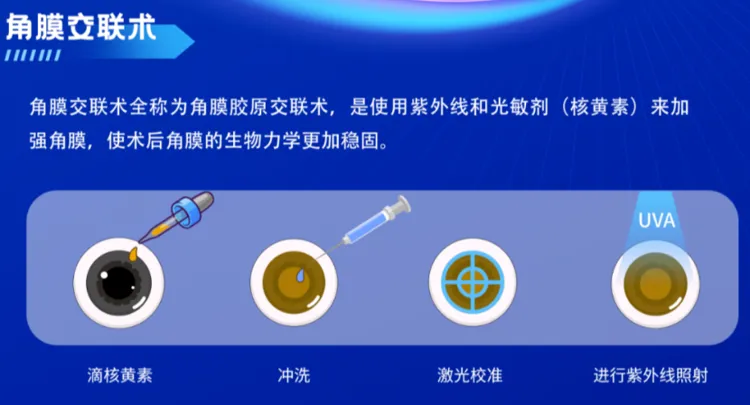
Corneal cross-linking is an ophthalmic treatment method mainly used to enhance the strength and stability of the cornea. This technique is typically used for treating corneal ectasia (such as keratoconus) and other corneal deformities. By using certain chemicals (such as nucleic acid and ultraviolet light), corneal cross-linking can promote the cross-linking of collagen fibers within the cornea, thereby increasing the rigidity and deformation resistance of the cornea. This treatment can help patients improve their vision and slow down or halt disease progression.
The corneal cross-linking (CXL) technique has a principle similar to that of "reinforcing the cornea": through ultraviolet irradiation or chemical induction, a cross-linking reaction is triggered in the collagen fibers of the stromal layer of the cornea, forming a denser "mesh" structure, which increases the biomechanical strength of the cornea. In simple terms, it is like weaving a loose "net" into a robust "armor," thus reducing the risk of corneal expansion or deformation after surgery.
Initially, this technique was used to treat keratoconus (a disease characterized by thinning and protrusion of the cornea), and then it gradually began to be applied to myopia surgery, especially in patients with thin corneas and higher degrees of myopia.
What myopia surgeries require a combined cross-linking treatment?
Not all surgeries for myopia require a cross-linking treatment; the following situations may suggest its combined use:
01. Laser surgery for high myopia.
Patients with high myopia need to resect more corneal tissue, which may bring the remaining corneal thickness close to the safety limit (the international standard stipulates that the remaining corneal stromal thickness should be ≥280μm). In this case, combining with the cross-linking technique may increase the biomechanical strength of the cornea and reduce the risk of postoperative corneal expansion.
02. Patients with thin corneas.
The normal central corneal thickness is about 500-550 μm. If the corneal thickness before surgery is less than 480 μm, even if the myopia is not high, there may not be enough remaining corneal stromal layer after the operation. The cross-linking technology can help alleviate the associated risk with insufficient thickness through a "strengthening" effect.
03. Patients with secondary enhancement surgery or irregularities in corneal morphology.
Some patients experience regression in their degree after the first surgery, requiring a second reinforcement surgery; or they may present mild corneal irregularities (such as an early tendency toward keratoconus), and the cross-linking technique can increase corneal stability and reduce postoperative complications.
The corneal cross-linking technique is not a "standard" for all myopia surgeries, but it has opened the "door to glasses removal" for patients with deficient corneal conditions. If you have doubts about surgery due to low corneal thickness or high degrees of myopia, I recommend consulting a specialized doctor to assess whether it is necessary to combine it with cross-linking. After all, safe clarity is the true "glasses-free freedom".
Discussion topic: Is there anyone around you who has undergone myopia surgery? Do you know about the corneal cross-linking technique? I invite you to share your opinions in the comments!
Medical disclosure is for reference only and should not be used as a basis for diagnosis or treatment.
Source content: Expert consensus on corneal cross-linking surgery for the treatment of expansive corneal diseases (2023). Zhang Jia, Liu Chang, Li Yini, et al. Therapeutic laser keratectomy combined with corneal cross-linking for the treatment of primary keratoconus. Journal of Ophthalmology and Visual Sciences in China, 2018, 20(5):5. DOI:10.3760/cma.j.issn.1674-845X.2018.05.008.
熊洁, Zhang Chenxing, Wang Ke, et al. Clinical observation of all-femtosecond small-incision corneal stromal lenticule extraction combined with accelerated corneal cross-linking for high myopia with thin corneas. Journal of Third Military Medical University, 2019, 41(24):7. DOI: CNKI:SUN:DSDX.0.2019-24-014.
#salud
#oftalmología


© 2025 Tribu Salud.