
4 hábitos que perjudican la vista de los niños en vacaciones
feb 08, 2026
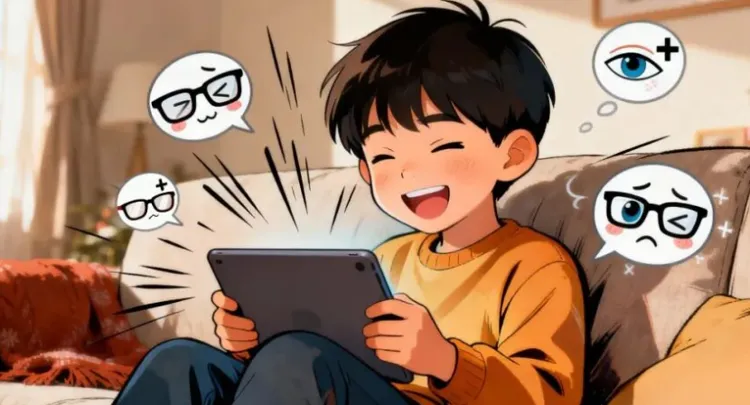
Title: 4 habits that harm children's eyesight during vacations Profile: Winter vacations can increase myopia in children. It is vital to correct visual habits and promote eye check-ups.
The winter vacation has begun! Children can finally set aside their backpacks and relax, but parents must be cautious, as this is a "high-risk period" for increased myopia in children! Many little ones at home feel "completely liberated," doing their homework with their heads tilted, getting too close to tablet screens, and rubbing their eyes with dirty hands... These small, seemingly common habits are silently damaging children's eyesight. Today, I will present four of the most harmful habits for the eyes, along with practical methods to correct them. Parents, take note!
Bad Habit 1: Tilting the head while doing homework, which causes "unequal pressure" on the eyes and can lead to deformations.
During winter vacations, many children spend time at home doing homework and crafts. When there is no one to supervise them closely, many develop habits like tilting their heads or reading while lying down. It should not be thought that this only affects the spine; the damage to the eyes is even more direct!
Under normal conditions, our two eyes "collaborate" efficiently, adjusting the ciliary muscles for clear vision. However, by tilting the head, the angle of vision between the two eyes becomes different, forcing one eye to "exert itself" more to achieve clear focus. Over time, this can result in a greater difference in the degree of myopia between both eyes (known as "anisometropia"). Even more concerning, tilting the head can cause continuous pressure on the eyeball, altering the curvature of the cornea, which not only worsens myopia but can also induce strabismus, causing the child's eyes to deviate further.
Correction small tricks.
It is essential to ensure that children maintain correct posture: back straight, book or screen at a distance of 30-40 centimeters from the eyes, avoiding bending or leaning for extended periods. Parents can periodically remind them or place a reminder note about posture next to the desk.
Bad Habit 2: Looking at things too closely, causing the eye's "muscles" to collapse.
It does not matter whether they are reading books, viewing picture albums, using tablets, or playing with phones; many children tend to get too close to the screens. When parents tell them to back off a bit, they adjust momentarily, but soon return to getting too close. This "near vision use" is undoubtedly the "main culprit" for worsening myopia.
Our eyes are like precision cameras, with the ciliary muscles adjusting the focus. When children look at objects too closely, the ciliary muscles must contract continuously, which can lead to fatigue and spasms, preventing them from relaxing. This causes the degree of myopia to naturally increase. Especially during the winter holidays, when children spend a lot of time without letting go of electronic devices, the ciliary muscles have no chance to rest; will the degrees of myopia not rise?
Small tips for correction.
Remember the "20-20-20" rule: every 20 minutes of studying, look at an object 6 meters away for 20 seconds to relax the eyes.
Control screen time: Children should not use near vision for more than 4 hours a day, electronic device usage should be limited to a maximum of 1 hour per day, and each time not exceed 20 minutes.
Choose the right electronic device: Try to use large screens, such as TVs or tablets, and avoid children using mobile phones for prolonged periods. Additionally, adjust brightness and contrast appropriately, neither too bright nor too dark.
Bad Habit 3: Rubbing the eyes with hands allows bacteria to "enter" and harm the eyes.
Children at home play with toys for a while, then touch snacks, and with their little hands, they touch and handle everything, accumulating germs, but they always tend to rub their eyes unconsciously. Many parents see this as a minor problem, but it can actually be very harmful!
Firstly, the bacteria and dust on hands can be rubbed into the eyes, leading to conjunctivitis and keratitis. Children may experience redness, itching, and increased eye discharge, and in severe cases, this could affect vision. Secondly, the pressure applied when rubbing the eyes can deform the curvature of the cornea, worsening myopia. If the child already has astigmatism, rubbing the eyes could exacerbate the degree of astigmatism, impacting subsequent corrections.
Small tricks for correction.
Encourage the habit of "washing hands regularly": after children play with toys or finish eating snacks, it is crucial for them to wash their hands carefully with soap, preventing dirty hands from touching their eyes.
Address any eye discomfort promptly: if the child rubs their eyes and shows redness, pain, or sensitivity to light, do not use medications on your own; take them immediately for an eye examination.
Bad Habit 4: Doing homework in a dark environment, causing the eyes to become "overloaded" and fatigued.
Some parents think that for children to do homework at home, all that is needed is to turn on a small desk lamp; while other children prefer to curl up on the sofa or bed, reading or doing homework in dim light. Unknowingly, a poorly lit environment is silently wearing down children's eyesight.
When the light is too dim, children tend to get closer to the book without realizing it, for clear visibility of the letters, causing the ciliary muscles to contract excessively to adjust the vision. This significantly increases the burden on the eyes and may easily lead to visual fatigue. Using vision in a dark environment for extended periods not only accelerates the worsening of myopia but can also cause children to experience eye discomfort, dizziness, and lack of concentration, which also impacts their learning efficiency.
Small tricks for correction.
Create a "scientific light source for eye care": prepare a suitable desk lamp for children and place it to the left front of the desk, avoiding direct light in the eyes or reflection on the books; simultaneously, turn on the main light of the room to form a double light source "desk lamp + main light," ensuring that the environmental lighting is adequate and soft. Note that the intensity of the main light source must reach over 500 lux, while the desk area should reach between 500 and 1000 lux. During the day, curtains can be opened to take advantage of natural light, but direct sunlight should be avoided.
It is strictly prohibited to allow situations of poor visual hygiene: do not let children read or do homework on the sofa, bed, or blanket. These places not only have poor lighting but also contribute to careless posture, resulting in double harm to eyesight.
During winter vacations, parents should also do these three things to care for their eyesight.
In addition to correcting bad habits, parents must take proactive measures to better protect their children’s vision:
Spend 2 hours outdoors every day: Outdoor activities are a "natural remedy" to prevent myopia! During winter vacations, take children to parks or fields to walk and play, allowing their eyes to have more contact with natural light, which can help delay the progression of myopia.
Have a complete eye exam: take children to a regular eye care institution for an examination, which includes measuring vision and the length of the eye axis. It is important to conduct "four checks and one record": check hyperopia reserve (children aged 6 ≤ 75 degrees, 7 to 8 years ≤ 50 degrees, 9 to 10 years ≤ 25 degrees, 11 to 12 years 0 degrees; values below this indicate risk of myopia), check true and false myopia (false myopia does not present diopters after dilation; poor lens adjustment can turn it into true myopia), check the progression of myopia, and assess the risk of high myopia (alert if there is a family history of high myopia, if the child shows myopia in preschool age, or if the degree changes rapidly, as it could trigger complications such as glaucoma or cataracts).
Many children love playing with their phones because they learned from their parents. During winter vacations, parents should set aside their phones and spend more time with their children doing family games and outdoor activities. It is important to replace screen time with quality companionship, thus helping children free themselves from reliance on electronic devices.
Winter vacations are a time for children to relax, but do not let bad visual habits affect their vision! Parents, please follow the methods mentioned above to help your children correct bad habits and take good measures to care for their eyes, allowing them to enjoy a happy winter vacation while protecting their "window to the soul." If you notice any abnormalities in your child's vision, be sure to see a doctor in time.
#salud infantil
#cuidado de la vista


© 2025 Tribu Salud.