
Los ungüentos comunes en casa podrían contribuir a crear bacterias resistentes
feb 16, 2026
Authors: Wang Zhonghai, Class 2 of Pharmacy from the 23rd level of the School of Pharmacy at Chongqing Wenli University, and Yang Xueying, Class 2 of Pharmacy from the 24th level of the School of Pharmacy at Chongqing Wenli University. Teaching guide: Dr. Luo Jie, associate professor at the School of Pharmacy, Chongqing University, and Head of Technicians, Zuo Jingbo from the Yongchuan District Center for Disease Prevention and Control, Chongqing. Support project: Theme of the Chongqing Scientific Research Association (Key Project) 2024CQKPB008. Recommended unit: Science and health volunteer team of the Red Cross in Yongchuan, Chongqing (Professor Zou's scientific outreach garden).
Title: Common ointments at home could contribute to creating resistant bacteria. Profile: The misuse of erythromycin ointment can increase bacterial resistance; it is crucial to correctly identify skin problems. Keywords: ['Medication safety.', 'Antibiotics'].
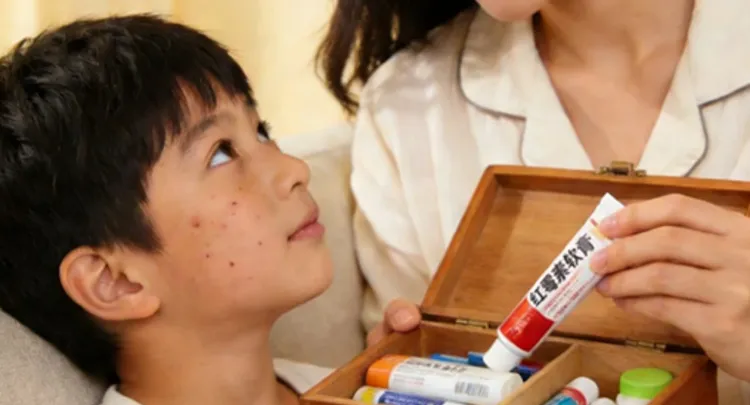
In almost every household medicine cabinet, there is a tube of erythromycin ointment. When a child develops a few small red spots on their face, sustains a cut on their hand, or is bitten by mosquitoes, many people's first reaction is to think, 'We need to reduce inflammation,' and applying erythromycin ointment becomes the first choice. It is inexpensive, easy to obtain, and convenient to use, making people gradually consider it a 'miraculous ointment' for minor skin problems.
However, this small erythromycin ointment cannot solve all problems. That random application you made may be in the wrong place, creating silent risks for your future health.
First, clarify: what exactly is the problem?
Erythromycin is a macrolide antibiotic that acts by inhibiting protein synthesis in bacteria, being effective against bacteria like staphylococci and streptococci. For this reason, it is used to treat bacterial skin infections such as impetigo, as well as in the auxiliary treatment of small burns. However, many skin problems are not caused by bacteria; applying erythromycin in these cases is not only useless but could worsen the situation.
Acne is often confused with 'inflammation,' but its primary cause is pore blockage and excessive oil production, which has little relation to bacteria. Daily application of antibiotics is akin to watering a plant with concentrated fertilizer: it disrupts the microbiota, and when the skin is truly infected with bacteria, the medication will no longer be effective.
Athlete's foot and ringworm are fungal infections. Erythromycin does not act against fungi, so applying it has no effect and might eliminate beneficial skin bacteria. By removing their natural predators, fungi can proliferate even more.
Mosquito bites, which cause allergies and rashes, are characterized by redness, swelling, and itching, indicating an inflammatory reaction that is not related to bacteria. Antihistamine medications should be used to relieve itching and allergy; using antibiotics in this case would be a total mistake.
Small abrasions and blisters from burns should be treated by cleaning the wound and keeping it dry; this way, it will heal on its own. Immediately applying a layer of ointment can actually occlude the wound and slow down recovery. If the injury is severe, it is necessary to see a doctor immediately.
Second, drug resistance is related to each time you act 'lightly'.
Bacteria, although tiny, can survive, spread, and mutate. Each time antibiotics are used, there is a fear that susceptible bacteria will be eliminated while those that are naturally resistant survive, continue to reproduce, and, from generation to generation, give rise to what are known as 'superbugs,' which are resistant to any treatment.
Today, by applying erythromycin once, you help resistant bacteria eliminate a group of rivals; tomorrow, by applying it again, they become even stronger. You think you are preventing diseases or addressing minor problems, but in reality, you are training the bacteria.
Now many families always have erythromycin ointment on hand; if they get a cut on their hand, they apply it, if a blister forms on their foot, they put it on, and if they have dry skin on their face, they also use it. It seems like this ointment can cure any disease. But when you actually face a severe infection and rely on antibiotics to save you, you might realize: the medication, why is it not working?
This is not to scare you. The abuse of antibiotics has become one of the most difficult public health problems globally. That unassuming little ointment in your hand is actually connected to your future health by a thread.
Third, how should erythromycin be used correctly? Use it only when necessary.
Medicine can save lives, but it can also cause problems; everything depends on whether it is used correctly.
First, identify who the enemy is. If you have skin problems, the first step is not to look for medications but to find out the cause: bacteria? Fungi? Allergies? If you are unsure, ask a doctor or pharmacist, do not rely on assumptions.
Do not confuse 'anti-inflammatory' with 'antibacterial.' Most redness, swelling, heat, and pain of the skin are not caused by bacteria; why are you insisting on eliminating bacteria? You are working in vain and may even be causing more problems.
Every medication has its indications. Erythromycin is only effective against specific bacteria; do not expect it to treat athlete's foot, allergies, or burns.
Policies are not designed to complicate your life but to protect what you have. Nowadays, control over antibiotics is strict; it is not a way to make your life difficult but because there is a fear that you will exhaust all available medications.
In the medicine cabinet, a sincere wish for your well-being is stored.
Using erythromycin ointment as a miraculous ointment, in short, is due to it being cheap, convenient, and feeling safe to apply. This sense of security should be based on an adequate understanding of the facts.
You should know when it is time to use it and, even more, when it is better to leave it in the medicine cabinet. In those bottles and packages in the cabinet, there is not only medication, but also the desire to care for oneself and for the family. This desire is not based on accumulating medications but on knowing medications, understanding diseases, and knowing how to handle situations, all built up little by little.
Next time you open the medicine cabinet, when your fingers touch that tube of erythromycin ointment, why not ask yourself: this time, do I really need to take it out?
This question takes only a few seconds but could be the most practical 'medication experience' of your life.
References:
Mao Yu. Research on the situation of human mycoplasma infections and macrolide antibiotic resistance. [Thesis]. Dalian Medical University, 2007.
Hu Yan. Research on the cognition and factors influencing the application of antibiotics by clinical doctors in Taiyuan City [D]. Shanxi Medical University, 2014.
Zhongsheng Shi. Why are antibiotics ineffective in treating pharyngitis? [J]. Family Medicine, 2014, (07): 26.
#antibióticos
#seguridad en el uso de medicamentos.


© 2025 Tribu Salud.