
¿Qué causa el ardor en el pecho si no es el corazón?
feb 27, 2026
Title: What Causes Chest Burning If It's Not the Heart? Profile: Burning after overeating is due to irritation of the esophagus by stomach acids. Improving diet helps to avoid it. Keywords: ['Health.', 'Digestion'] Author: Li Haoyan, undergraduate student of the 24th Clinical Medicine cohort at Chongqing Medical University. Reviewer: Wang Yang. Teaching guide: Xu Lei, associate professor of the Department of Immunology and Pathogenic Biology at Chongqing Medical University, and Zhou Jingbo, chief technician of the health science volunteer team of the Red Cross in Yongchuan, Chongqing (Professor Zou's Scientific Dissemination Garden) (Popular Science Expert in China). Producing Unit: Chongqing Microbiology Society. Statement: Except for original content and special indications, some images are sourced from the internet, are not for commercial purposes, and are used solely for knowledge dissemination materials. Copyright belongs to their respective authors. If there is any infringement, please contact us for removal.
Many friends from the Chuan and Yu regions may have had this experience: after finishing a meal and returning home, satisfied while lying in bed and using their phones, they suddenly feel a burning sensation in the back of their chest, accompanied by an acidic taste rising to the throat. This sensation is especially common after a spicy hot pot meal and many friends refer to it as 'heartburn'.
In fact, this 'heartburn' experience is mostly unrelated to the heart but is due to irritation of the stomach leading to reflux, which stimulates the esophagus.
Why is it that discomfort in the chest is often the first sign when there is a problem with the stomach? This is because there is a sphincter between the stomach and esophagus, and when the stomach is uncomfortable or has issues, it may cause acidic liquid to flow back into the esophagus, irritating the esophageal nerves and thereby producing discomfort in the chest. Additionally, the sensory nerves of the stomach have certain intersections and connections with the nerves in the chest, causing discomfort signals to be sensed in the chest. Overall, chest discomfort caused by stomach issues is a common symptom.
This is due to our imprecise internal 'alarm system.' The sensory neurons of the esophagus and the heart use the same signal pathway to reach the brain. When stomach acid irritates the esophagus, nerve signals return to the spinal cord, and the brain tends to confuse them: "A signal from the chest? It must be the heart." Thus, a misunderstanding arises. In medicine, this is known as referred pain; the organ that is truly in trouble and the location of the pain sensation are not the same. Therefore, the term 'acidity' turns out to be a typical case of confusion. What is really 'burning' is not the heart, but the esophagus, the muscular tube that runs from the throat to the stomach.
The 'heartburn' originates from this location: at the junction of the esophagus and stomach, there is a ring of special muscles called the lower esophageal sphincter (LES). Normally, it acts as a responsible guard: food can go down, but nothing from the stomach content should come up.
However, in some situations, this security guard can also fail.
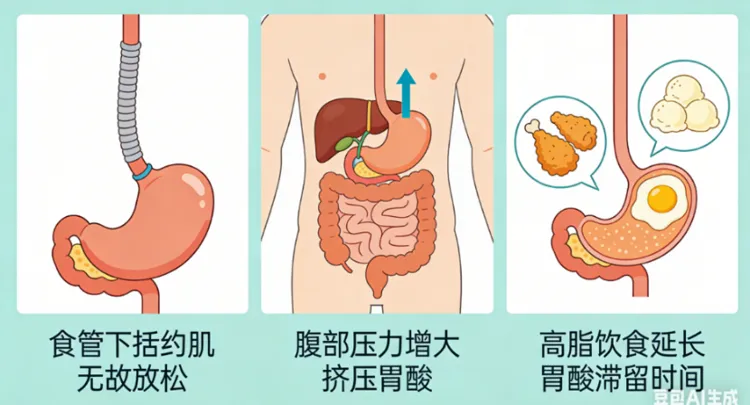
The lower esophageal sphincter relaxes 'lazily.' Sometimes, this ring of muscle relaxes suddenly for no apparent reason for a few seconds, giving stomach acids the opportunity to reflux.
After a large meal, bending over to pick things up, wearing tight pants, being obese, or being pregnant increases the pressure in the abdomen, similar to squeezing a tube of toothpaste and pushing stomach acid back into the esophagus.
A high-fat diet and binge episodes prolong the retention time of gastric acid, increasing the risk of acid reflux.
Compared to the stomach wall, which has a thick mucous barrier, the esophageal mucosa is much more delicate. When the mentioned situation occurs, the hydrochloric acid from the stomach mixes with a series of digestive enzymes and refluxes into the esophagus, leading to deterioration of the esophageal mucosa and damage to the esophagus; this is the essence of heartburn.
Isn't it just acid reflux? You just have to bear it and it will pass—this is the most dangerous thought. Allowing the esophagus to be in contact with stomach acid for a long time has progressively severe consequences.
Esophagitis. The esophageal mucosa gets repeatedly burned by acid, causing erosions and ulcers. At this time, you may feel pain when swallowing and even difficulty swallowing.
Barrett's esophagus. Under prolonged stimulation, the normal cells in the lower esophagus 'despair,' deciding to mutate to survive, transforming into cylindrical epithelial cells similar to those in the intestine. The risk of the patient developing esophageal adenocarcinoma is usually higher than in the general population.
Esophageal stricture or cancer may occur. The repeated lesions and their repair can form scars, causing the esophagus to narrow increasingly, making it difficult to even swallow water.
But there is also good news, gastroesophageal reflux disease can be controlled through adjustments in lifestyle habits.
① Eating habits:
Reduce high-fat, spicy, and acidic foods.
Reduce coffee, alcohol, and chocolate consumption.
Do not eat three hours before bedtime.
② Sleep habits:
Do not lie down within 2-3 hours after meals.
Appropriately raise the head of the bed.
Weight and clothing:
Weight loss, abdominal fat is the greatest enemy of the LES since it constantly exerts upward pressure.
Quit smoking; nicotine relaxes the sphincter.
Wear loose clothing; give up those tight pants around the waist and girdles.
Gastroesophageal reflux disease may seem 'a little uncomfortable', but in reality it is a distress signal sent by the body. Next time you face a pot of hot pot with red oil, remember the unreliable 'guardian of the esophagus' LES. Take better care of it, eat a little less, and stand up for a while longer; your esophagus will thank you.
References:
1. Lynn, R.B., Mechanisms of Esophageal Pain. Am J Med, 1992. 92(5a): p. 11s–19s.
2. Chinese Society of Medicine, Digestive Diseases Association, Gastrointestinal Motility Group, et al. Standards for the Diagnosis and Treatment of Gastroesophageal Reflux Disease in China. Gastroenterology, 2023. 28(10): p. 597–607.
3. Tack, J. and J.E. Pandolfino, Pathophysiology of Gastroesophageal Reflux Disease. Gastroenterology, 2018. 154(2): p. 277–288.
4. Hvid-Jensen, F., et al. Incidence of Adenocarcinoma among Patients with Barrett's Esophagus. N Engl J Med, 2011. 365(15): p. 1375–83.
5. Ness-Jensen, E., et al. Lifestyle Intervention in Gastroesophageal Reflux Disease. Clin Gastroenterol Hepatol, 2016. 14(2): p. 175–82.e1–3.
Producer unit: Chongqing Microbiology Society.
#salud.
#digestión



© 2025 Tribu Salud.