
Trastornos de la marcha en Parkinson: soluciones y cuidados en casa
feb 27, 2026
Title: Gait Disorders in Parkinson's: Solutions and Home Care. Author: Wang Yuxuan, Gao Caiping, Wu Yunfeng. Review: Zhai Hua, Party Secretary of Yangzhi Rehabilitation Hospital, Vice President of the Scientific Dissemination Committee of the Chinese Society of Rehabilitation Medicine. Editor: Jia Jing, Xinhua Hospital, Shanghai Jiao Tong University School of Medicine. Unit: Neurological Rehabilitation Center of Yangzhi Hospital in Shanghai.
Parkinson's disease is a common neurodegenerative disorder in middle-aged and elderly individuals. Its primary motor symptoms include bradykinesia, resting tremor, muscle rigidity, and gait disturbances. Among these, gait disorders frequently manifest as motor dysfunction in Parkinson's disease, particularly in the middle and advanced stages of the illness. Patients find it increasingly difficult to initiate movement, walk, and turn, exhibiting hurried gait, freezing of gait, and balance problems, which have become significant causes of falls and disability in people with Parkinson's.
1. Why do patients with Parkinson's disease experience gait problems?
The underlying issue in Parkinson's disease is the degeneration of dopaminergic neurons in the brain, leading to insufficient secretion of dopamine, an important neurotransmitter. Dopamine acts as the 'commanding officer' coordinating body movements, and its deficiency can hinder the transmission of motor commands, resulting in several problems:
1. Bradykinesia: shorter steps and reduced walking speed.
2. Freezing of gait: it feels as if the feet are glued to the floor, unable to take a step, especially when starting to move, turning, or passing through a narrow doorway.
3. Forward lean: the body involuntarily leans forward, necessitating acceleration with small steps to maintain balance.
4. Loss of postural reflexes: worsening balance, leading to an increased risk of falls.
5. Reduced arm movement: while walking, coordination diminishes, and the natural action of synergy is missing.
2. Home Care and Rehabilitation Guidelines for Patients with Parkinson's Disease.
1. Gait training. Since patients may display short steps, difficulties advancing, and challenges turning, during gait training, they are instructed to look forward while keeping their body upright. The upper limbs should coordinate with the lower limbs when initiating walking and perform harmonious movement. It is essential that the first step is wide; if it is too small, the patient may adopt an erratic gait. If an erratic gait occurs, the training should be interrupted immediately, and the patient should rest momentarily before restarting. If forward training progresses well, the patient can be encouraged to attempt backward movements to practice weight shifting.
2. Muscle strength training to improve lower limb stability.
(1) Static wall squats: Lean against the wall, bend the knees to form a 90-degree angle, and hold the position for 30 seconds, performing three sets per day.
(2) Toe training: Support yourself with both hands on the back of a chair and slowly rise onto your toes 10 times, performing 3 sets to prevent foot falls.
3. Turning training: When the patient needs to turn, sudden stops and turning in place should be avoided. Better gait continuity can be assured by increasing the turning radius. When the patient is in a confined space and needs to turn, one leg can serve as an axis, and under rhythmic instructions (such as 'one, two, one'), a rhythmic step can be taken to complete the turning movement.
4. Balance training.
(1) Tai Chi Yunque: Stand with feet 25-30 cm apart, slowly twist the waist side to side, transferring weight from one side to the other, thereby improving balance and relieving muscle tension.
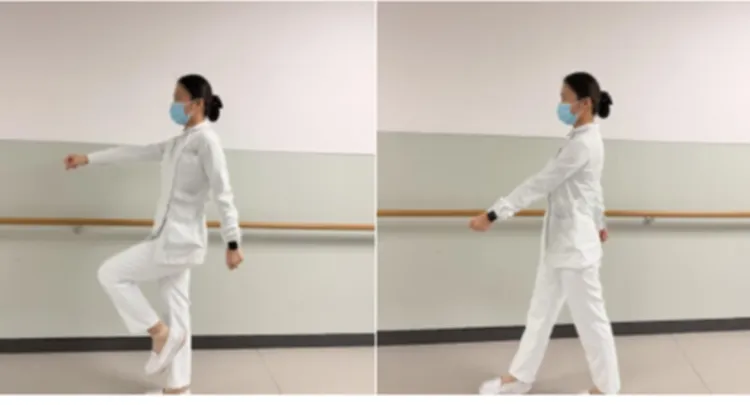
(2) Single-leg hold: Support yourself against the wall and keep one leg raised, starting with 5 seconds and gradually increasing to 20 seconds.
3. In daily life, the following can be done.
We must boost confidence, provide good psychological intervention, and alleviate freezing anxiety.
2. Reduce anxiety while walking through mindfulness meditation. Upon waking, perform 10 minutes of ankle pump exercises: lie on your back and flex your feet 10 times to activate calf muscles.
Non-slip shoes and vibration belts can be used to aid safe walking in daily life. It is advisable to remove thresholds, cables, and other obstacles indoors and install motion sensor night lights. In the bathroom, grab bars and non-slip mats should be added to reduce the risk of falls.
4. Focus on walking; do not talk or look at your phone simultaneously. Concentrate on taking long steps and moving your arms.
5. How to cope with freezing: once you feel your feet are stuck, do not force the movement. Stop, stand still, and take deep breaths. Then, try moving your body rhythmically from side to side, or imagine a line in front of you that you need to cross before attempting to take the first step.
6. Turning technique: avoid twisting the upper body directly; try to make a 'U' shaped turn, like a boat making a turn.
Freezing of gait is a very dangerous symptom that can be triggered by uncontrollable factors such as patient anxiety, road congestion, or changes in terrain, which can be very frustrating. In the clinic, the importance of receiving treatment and maintaining medication for Parkinson's disease is emphasized. Furthermore, under protected conditions, it is beneficial to continue practicing exercises and training trunk balance, which helps reduce balance disorders while walking.
【References】
[1] Neurology Commission of the Chinese Medical Association, Parkinson's Disease and Movement Disorders Study Group of the Chinese Medical Physicians Association. Treatment Guidelines for Parkinson's Disease in China (4th Edition). Chinese Neurology Journal, 2020, 53(12): 973.
Zhang Qingshuo, Song Dandan, Zhou Shiyue, et al. Diagnostic and therapeutic functions of gait disorders [J]. Modern Chinese Neurological Diseases Journal, 2023, 23(07): 604-609.
Wang Jintao, Li Guozhen, Wang Gang. Emphasis should be placed on the diagnosis and treatment of functional nervous system diseases. Modern Chinese Neurological Diseases Journal, 2023, 23: 53-57.
[4] Chinese Medical Association, Neurology Section, Parkinson's Disease and Movement Disorders Working Group, Chen Shengdi, et al. Expert Consensus on Managing Gait Disturbances in Parkinson's Disease in China [J]. Chinese Neurology Journal, 2025, 58(3): 228-243.
END


© 2025 Tribu Salud.