
5 dimensiones para aliviar el dolor y rigidez articular en invierno
ene 31, 2026
Title: 5 dimensions to alleviate joint pain and stiffness in winter. Profile: The cold can aggravate rheumatoid arthritis; Dr. Liu Jinsong suggests caring for Yang and following five measures to relieve pain. Keyword: ['health', 'traditional Chinese medicine'].
The severe cold has arrived, and during this winter season, the sensation of cold is intense. For patients with rheumatoid arthritis, the extreme cold seems to be a "double-edged sword"; when the icy wind blows, the joints become the most sensitive "alert system". At the slightest attack of cold, the sensation of pain and stiffness appears punctually.
In reality, there is no need to worry. The wisdom of traditional Chinese medicine, which has endured for millennia, contains valuable formulas to help joints get through the winter smoothly. Dr. Liu Jinsong, director of the Department of Rheumatology and Immunology at the Hunan Province Hospital of Traditional and Western Medicine (Affiliated Hospital of the Hunan Traditional Chinese Medicine Research Institute), explains this practical approach to winter health for joints from five dimensions: Yang protection, supplementary nutrition, acupressure, exercise, and emotional adjustment.
First, health in the Great Cold, caring for Yang is key.
1. The cold reaches its peak, and Yang energy is deeply hidden and must be protected. Traditional Chinese medicine considers the great cold to be a time when 'the cold reaches its extreme and Yang energy is hidden deep'. At this moment, nature presents its greatest coldness and the Yang energy of the human body is internal, like buried seeds, which require special care to avoid exhaustion. Rheumatoid arthritis, according to traditional Chinese medicine, belongs to 'obstruction syndromes', often caused by wind, cold, and humidity blocking the meridians, hindering energy and blood circulation. Protecting Yang energy in the body during the period of great cold and preventing the cold from penetrating deeply is equivalent to building a 'wall against the cold' for the joints.
2. Extreme cold can easily cause energy and blood to stagnate, which can damage the joints. Severe cold causes the contraction of the meridians, slowing down the circulation of energy and blood, leading to insufficient nutrition for the joints — it is as if the doors are tightly closed, obstructing the internal and external flow. The great cold is just before and after the period of 'Si Jiu', being the coldest stage of the year, so preventing cold and caring for warmth are of utmost importance!
Second, nutrition as remedy: eat to 'warm the joints'.
Caring for Yang in the Great Cold is fundamental, and diet is the most direct method of 'internal warming'. Traditional Chinese medicine emphasizes the idea that 'food and medicine come from the same source', so through ingredients of warm nature, blood can be nourished, Yang can be warmed, and kidneys can be strengthened. This not only helps dispel humidity and cold in the joints but also provides an extra boost of Yang energy to the body.
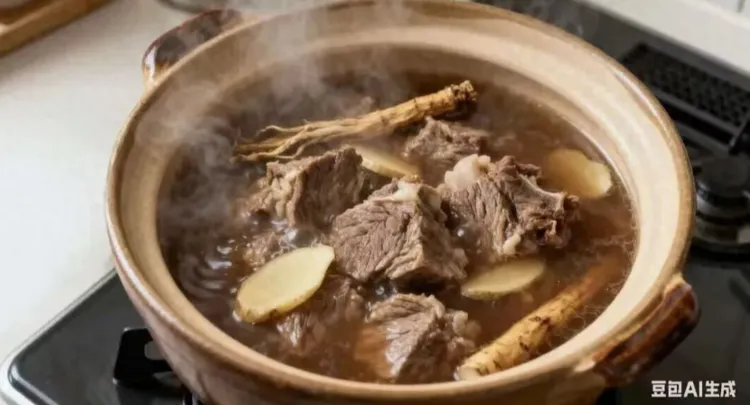
1. Lamb soup with angelica and ginger: the 'shield against cold' for the joints. This recipe, from the 'Treatise on the Storage of Herbs', is a perfect companion for joints in cold winter.
Ingredients: 20 grams of angelica, 30 grams of ginger, 500 grams of lamb meat.
Method: After blanching the lamb, cook it with the medicinal herbs for 2 hours. You may add a little yellow wine to enhance the aroma.
Benefits: Dong Quai nourishes and activates the blood, ginger dispels cold and evils, and lamb meat tonifies energy and combats weakness, working together to eliminate humidity and cold in the joints. It is recommended to do this 1 to 2 times a week to warm the whole body.
2. Rib soup with black beans and walnuts: nourishes the kidneys and strengthens the bones. Traditional Chinese medicine considers that 'the kidneys are the domain of the bones and produce the marrow', so nourishing the kidneys reinforces the joints. Ingredients: 50 grams of black beans, 30 grams of walnuts.
Preparation: Soak the black beans and walnuts beforehand, and cook them together with the ribs. Add two slices of ginger to balance the richness of the dish. The black color enters the kidneys, especially suitable for friends suffering from pain in the waist and knees, as well as cold sensitivity.
3. Little tea drinks have a big impact:
Cinnamon and red date tea: 3 grams of cinnamon stick (to warm the kidneys and assist Yang) + 3 opened red dates. Infuse in boiling water, suitable for those with cold sensation in the waist and cold extremities.
Ginger and perilla leaf drink: 3 slices of ginger, 2 red dates, 5 grams of perilla leaves, add a piece of brown sugar. It is suitable to drink when feeling stiffness and discomfort in the joints after being exposed to the cold.
Third, massage acupoint: activates the body's 'heat switch' and opens the meridians.
The 'Yang heat switch' in the body is located at the point known as Zu San Li: it is located approximately four fingers below the depression on the outer side of the knee, at the position of the 'Qi and blood pump' of the legs and feet.
Press with the thumb and make circular motions clockwise for 3 to 5 minutes, once in the morning and once at night.
Effects: tonifies the spleen and warms the center, benefits energy and unlocks the meridians, increasing the circulation of Qi and blood in the lower extremities.
2. Guanyuan point: located approximately four fingers below the navel, is the location of the 'energy source' of the dantian.
According to the method: rub palms until warm and then massage in circular motions clockwise for 5 minutes, or perform moxibustion for 15 minutes (be careful not to burn yourself).
Effects: Nourishes vital energy, warms the first fire, and helps elevate Yang energy throughout the body.
3. Yanglingquan: on the outer side of the calf, in the depression just below the upper end of the fibula, is considered the 'opening point' of the knee joint.
Digital pressure: press with the thumb until feeling a tingling sensation, maintain for 30 seconds and repeat 5 to 8 times.
Effects: decongests the liver and gallbladder, relaxes muscles and joints, and specifically alleviates swelling and pain in the knees.
Fourth: Winter exercise: gentle and extensive, to avoid freezing and stiffness, promoting blood circulation.
To be 'active' and not 'stiff', with 'gentle stretching' as a principle.
Time: after 10 in the morning or from 2 to 4 in the afternoon, when Yang energy is stronger.
Place: It is best indoors. If the activity is outdoors, it is necessary to dress appropriately, paying special attention to the knees, ankles, and wrists.
Recommendation: Ba Duan Jin (Eight Pieces of Brocade) and Tai Chi Chuan (Tai Chi) — soft and slow movements, emphasizing the rotation and stretching of the joints, promoting the circulation of energy and blood.
Fifth, emotional maintenance: mental calmness, harmonization of energy and blood, protection of the joints.
Mental tranquility and energy and blood harmony: Traditional Chinese Medicine considers that 'cold causes stagnation, and emotions should flow freely'. In winter, the climate is severe, which can lead people to feel depressed, affecting the circulation of energy.
Suggestion: On a sunny day, face the sun for 20 minutes (do so according to your capacity and avoid cooling down) to absorb the natural energy of the sun. Listen to soft or energetic music to regulate your mood.
Cultivating tranquility through crafts: such as knitting, painting, paper cutting, among others, can not only brighten the spirit but also allow for moderate movement of the wrists and fingers.
Experts warn.
Director Liu Jinsong of the Hunan Province Hospital of Traditional and Western Medicine (Affiliated Hospital of the Hunan Academy of Traditional Chinese Medicine) warns that caring for rheumatoid arthritis is similar to accumulating energy in winter, and it needs to follow the seasons, caring both from within and outside. Utilizing the wisdom of traditional Chinese medicine, it is essential to protect the joints through comprehensive attention that includes nutrition, acupoint therapy, exercise, and emotional well-being, so that they can remain warm during the harsh winter.
Hunan Medical Chat Special Author: Hunan Province Hospital of Traditional and Western Medicine (Affiliated Hospital of the Hunan Institute of Traditional Medicine) Department of Rheumatology and Immunology Zhang Zihao Zheng Yanjiao
Follow @HunanMedChat for more information on health and science!
#salud
#medicina tradicional china

© 2025 Tribu Salud.